
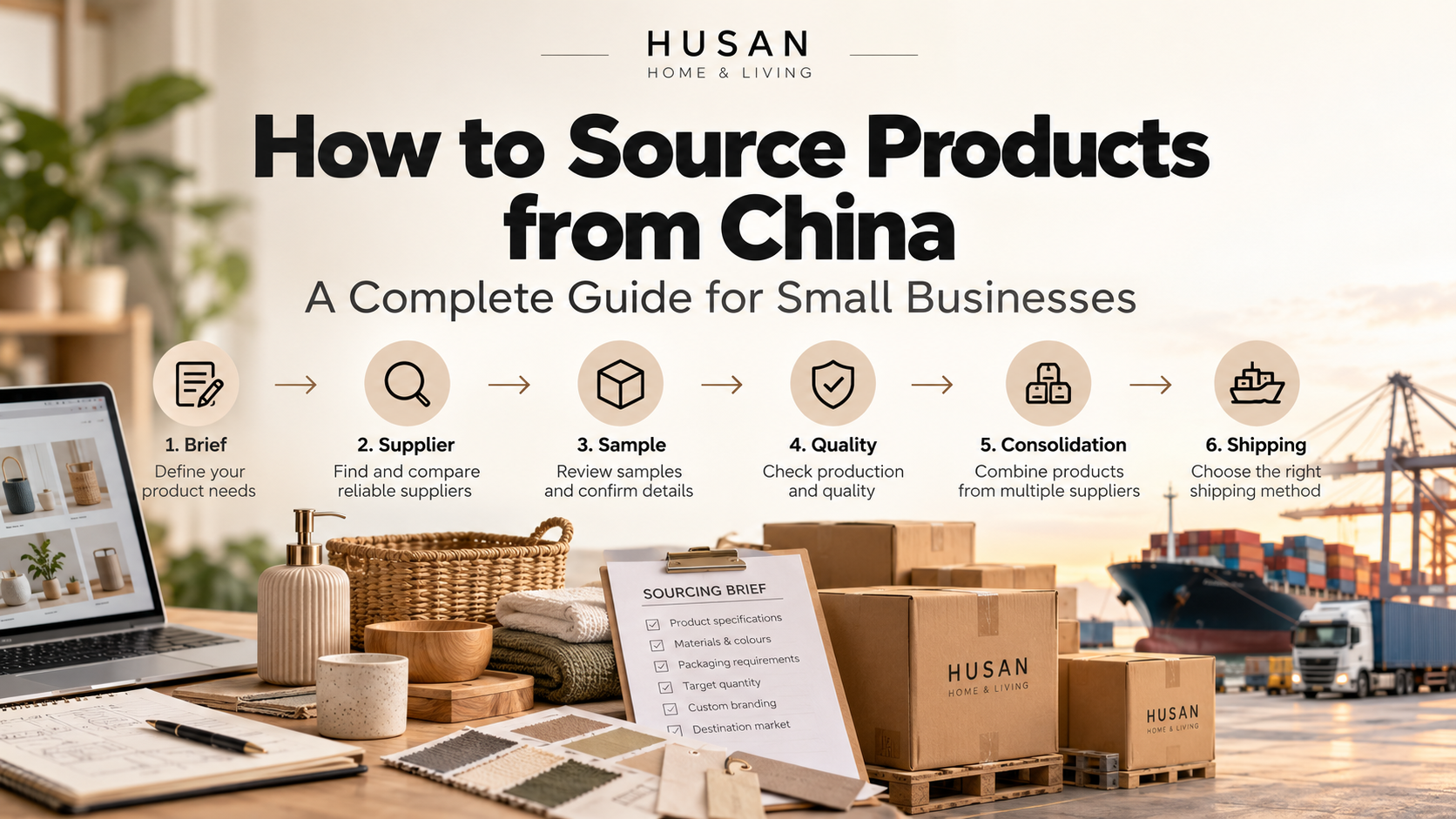
Sourcing products from China does not have to begin with a large container, a finished product specification or a major purchasing budget.
For an independent retailer, small wholesaler or growing brand, a better starting point is usually much simpler: understand what your customers need, define the product clearly enough to compare options, test the supply chain with realistic quantities, and confirm the details that affect your final cost before committing to a larger order.
This guide explains the practical sourcing process from the first product idea through supplier selection, samples, custom branding, quality checks, consolidation and shipping.
The exact requirements will vary by product and destination market, but the same principle applies throughout:
Do not make the purchasing decision on factory price alone.
1. Start with the customer, not the supplier
The first question is not:
Which Chinese supplier has the lowest price?
It is:
What product makes sense for my customers and my business?
A small home and living shop in Germany may need a very different product mix from an online retailer in Australia or a variety store in the Middle East.
Before contacting suppliers, write down:
- Where you sell
- Your sales channel
- Your target customer
- The problem the product should solve
- Your expected retail price
- Your approximate first-order quantity
- Any important size, colour, material or packaging requirements
This does not need to be a complete technical specification.
It simply gives the sourcing process a commercial direction.
For example, instead of asking for:
“storage baskets”
a more useful starting point would be:
“A neutral-colour storage basket for an independent homeware shop, suitable for shelves approximately 30 cm deep, target retail price €15–20, initial order around 100–200 pieces.”
That brief gives suppliers and sourcing partners something meaningful to work with.
2. Prepare a simple sourcing brief
A sourcing brief helps prevent different suppliers from quoting different interpretations of the same request.
Include the information you already know:
- Product reference photo, drawing or link
- Intended use
- Important dimensions
- Preferred materials
- Colour or finish
- Target quantity
- Packaging preference
- Branding requirements
- Destination country
- Target buying price, if you have one
Separate requirements from preferences.
For example:
Required
- Maximum width 28 cm
- Food-contact material suitable for the destination market
- Neutral colour
- Individual retail packaging
Preferred
- Bamboo-look lid
- Beige packaging
- Printed logo
This makes it easier to identify alternatives without accidentally changing something essential.
Related reading: How to prepare a Home & Living sourcing brief
3. Decide whether you need an existing product or a custom product
Not every sourcing project needs product development.
For a small business, an existing product can often be the lower-risk starting point.
There are roughly four levels to consider:
Standard product
An existing product is purchased with its normal specification and packaging.
This is usually the simplest route for testing demand.
Existing product with branding
The product remains largely unchanged, but an agreed logo, label, hangtag or packaging element is added.
Modified product
You request changes such as:
- Colour
- Size
- Material
- Packaging
- Component
- Finish
These changes may affect MOQ, sampling cost and lead time.
New product development
A new design may require tooling, prototypes, engineering work or multiple sample rounds.
For a startup, customisation should have a commercial reason.
Do not redesign a product simply because customisation is available.
4. Find suppliers that match the actual project
China has manufacturers, trading companies, wholesalers and specialist suppliers serving very different types of buyers.
The largest factory is not automatically the best supplier for a small retailer.
A supplier may produce excellent goods but require quantities far above your first-order needs.
Another supplier may accept smaller orders but have limited customisation capability.
When comparing suppliers, look at the fit between the supplier and your project:
- Does the supplier actually work with this product category?
- Can it support your expected quantity?
- Are the requested materials and specifications available?
- Can it provide samples?
- Can it support your packaging or branding requirements?
- How clear and consistent is its communication?
- Can the same specification be repeated on future orders?
For smaller businesses, supplier suitability matters more than supplier size.
5. Compare quotations beyond the unit price
Imagine two suppliers quote the same product.
Supplier A
USD 2.20 per piece
Supplier B
USD 2.45 per piece
It is tempting to conclude that Supplier A is cheaper.
But that conclusion may change when you compare:
- MOQ
- Product specification
- Packaging
- Inner carton quantity
- Master carton dimensions
- Sample charges
- Logo charges
- Tooling
- Domestic transport in China
- Inspection
- International freight
- Import duties and taxes
- Payment terms
- Defect risk
The purpose of a quotation is not simply to find the lowest number.
It is to make the offers comparable.
Ask suppliers to state assumptions clearly.
6. Understand MOQ before negotiating it
MOQ means Minimum Order Quantity, but the minimum may apply at different levels.
A supplier might require:
- 100 pieces per item
- 100 pieces per colour
- 500 pieces for custom packaging
- 1,000 pieces for a custom material
- A minimum order value rather than a piece quantity
Ask exactly where the minimum applies.
For small retailers, a slightly higher unit price with a manageable MOQ can sometimes be commercially safer than a lower price that forces you to hold too much inventory.
Consider the total cash tied up in the order, not only the unit saving.
7. Use samples to remove uncertainty
A product photograph is useful for finding options.
It is not enough for final approval.
A physical sample gives you an opportunity to evaluate what the customer will actually receive.
Review:
- Colour
- Surface finish
- Dimensions
- Material feel
- Construction
- Assembly
- Function
- Branding
- Packaging
- Instructions or labels where relevant
Record the sample version you received.
If you request changes, separate:
Accepted details
from
Changes required
This reduces ambiguity when the supplier prepares the next version.
Related reading: What to review when your custom sample arrives
8. Verify the supplier before committing to production
Supplier verification should match the value and risk of the project.
Depending on the order, this may involve reviewing:
- Company registration details
- Business scope
- Factory or trading-company role
- Production capability
- Relevant documentation
- Previous production experience
- Bank account information
- Factory audit findings
- Sample performance
Do not treat a marketplace profile, attractive showroom or sales presentation as a substitute for appropriate verification.
For higher-risk products or larger orders, the level of verification should increase.
9. Confirm product compliance for the destination market
Import requirements depend on what the product is and where it will be sold.
For example, the European Commission's Access2Markets system provides information on tariffs, rules of origin, taxes, customs procedures and product requirements for goods entering the EU. U.S. Customs and Border Protection similarly advises importers to check requirements specific to the commodity, including requirements administered by other government agencies. Trade and Economic Security
This means a supplier saying:
“We export this product regularly.”
is useful information, but it does not automatically establish that the product meets every requirement for your market.
Before production, clarify where relevant:
- Product standards
- Labelling
- Country-of-origin marking
- Safety requirements
- Material restrictions
- Test reports
- Packaging information
- Instructions
- Import documentation
The buyer should confirm the applicable requirements for the particular product and destination.
10. Treat packaging as part of the product
Packaging affects more than appearance.
It can influence:
- Damage rate
- Carton volume
- Freight cost
- Shelf presentation
- Barcode placement
- Online fulfilment
- Customer experience
Ask for:
- Individual packaging type
- Inner-pack quantity
- Master-carton quantity
- Carton dimensions
- Gross and net weight
- Labels
- Barcode requirements
- Protective material
A product that looks inexpensive at factory level can become commercially unattractive if its packaging is unnecessarily bulky.
For retailers, packed dimensions matter almost as much as product dimensions.
11. Confirm exactly what your shipping term includes
Do not use shipping terms as shorthand without understanding what they mean.
Incoterms® rules define responsibilities between buyer and seller around delivery, costs and risk. The ICC currently identifies Incoterms® 2020 as the latest edition and explains that different terms allocate transport responsibilities and risk differently. ICC - International Chamber of Commerce
For example, EXW, FCA, FOB, DAP and DDP do not mean the same thing.
A quotation should clearly identify:
- The agreed Incoterms® rule
- The named place or port
- What transport is included
- Who handles export arrangements
- Where risk transfers
- Who manages import clearance
- Which taxes and duties are included or excluded
Avoid comparing one supplier's FOB quotation directly with another supplier's delivered quotation as though the prices represent the same scope.
12. Inspect production when the risk justifies it
Sample approval does not guarantee that every production unit will automatically match the sample.
Before shipment, buyers may use appropriate quality checks depending on the order.
These can include:
- Quantity check
- Appearance
- Dimensions
- Workmanship
- Packaging
- Labels
- Functional checks
- Agreed specification points
Inspection scope should be designed around the product and the risks that matter.
For customised products, keep the approved sample and written specifications as references.
13. Consider consolidation when buying several products
Small retailers rarely need only one SKU.
You may be buying:
- Storage products
- Kitchen accessories
- Textiles
- Bathroom products
- Packaging
from different suppliers.
Shipping every order separately can create unnecessary complexity.
Where the products, timing and logistics allow it, goods may be collected and consolidated before international shipment.
A typical process may look like:
Supplier A → Supplier B → Supplier C → Consolidation point in China → One international shipment
Before assuming goods can be combined, confirm:
- Product characteristics
- Ready dates
- Carton dimensions
- Destination
- Transport restrictions
- Documentation
- Consolidation charges
Related reading: Mixed orders, chosen around your own shop
14. Calculate landed cost, not just factory cost
The number that matters to your retail business is not simply the supplier's unit price.
A simplified landed-cost calculation may include:
- Product cost
- customisation
- packaging
- China domestic logistics
- inspection
- international freight
- insurance where applicable
- customs charges
- duties and taxes where applicable
- destination handling
Then divide the relevant total by the sellable quantity.
That gives you a much better basis for deciding whether the product fits your target retail price and margin.
Customs treatment varies by destination and product. For example, EU importers can use Access2Markets to check tariffs and other applicable measures, while CBP reminds U.S. importers that commodity classification and other requirements need to be properly established. Trade and Economic Security
15. Start with an order you can learn from
Your first China sourcing order does not need to maximise purchasing efficiency.
It should give you useful information.
You are learning:
- Which products customers choose
- Which colours sell
- How quickly inventory moves
- How packaging performs
- Whether customers accept the price
- How long replenishment takes
- Whether the supplier can repeat the specification
For a startup, buying slightly less efficiently can be better than buying too much too early.
The first order should help answer:
Should we reorder this product?
not merely:
How low can we make the unit price?
A simple China sourcing process
For a small retailer, the process can be summarised as:
- 1. Define the customer need
- 2. Prepare the sourcing brief
- 3. Find suitable products and suppliers
- 4. Compare specifications and quotations
- 5. Verify the supplier
- 6. Review samples
- 7. Confirm compliance, branding and packaging
- 8. Approve the order specification
- 9. Produce and inspect
- 10. Consolidate and ship
- 11. Review sales and plan the reorder
The process does not need to be complicated.
It needs to be clear.
China sourcing checklist for small businesses
Before placing an order, confirm:
- Exact item reference
- Product specification
- Material
- Dimensions
- Colour or variant
- Quantity by SKU
- MOQ
- Sample approval
- Branding
- Packaging
- Carton quantity and dimensions
- Production lead time
- Quality requirements
- Required documentation
- Incoterms® rule and named place
- Shipping scope
- Import responsibilities
- Total estimated landed cost
- Payment terms
If one of the commercially important items is unclear, clarify it before paying the production deposit.
Do you need a China sourcing agent?
Not every order requires a sourcing company.
If you already know the product, have an established supplier and are comfortable managing specifications, quality and logistics, you may choose to work directly with the supplier.
A sourcing partner becomes more useful when you need help with several parts of the process, for example:
- Finding products beyond one supplier's catalogue
- Comparing suppliers
- Small-MOQ sourcing
- Custom samples
- Private label development
- Factory coordination
- Quality inspection
- Combining orders
- Shipping coordination
The important question is not simply:
“Should I use a sourcing agent?”
It is:
Which parts of the sourcing process do I need help managing?
How Husan works with independent retailers and growing brands
Husan Home & Living works with overseas independent retailers, small wholesalers and growing brands sourcing products from China.
You can start with:
- A product photo
- A product link
- A drawing
- A target category
- An existing Husan product
- Or simply a description of what your customers need
Our sourcing support can include product sourcing, supplier coordination, factory audits, custom samples, sample evaluation, mixed-product orders, consolidation and shipping coordination, with the exact scope confirmed for each project.
We also accept sourcing requests for products that are not currently shown in the Husan collection.
For smaller buyers, the objective is not to prescribe a large fixed bundle.
It is to build an order around the products and quantities that make sense for your shop.
Small MOQ · Mixed Products · Consolidated Shipping
Explore Husan's current products or send us your sourcing brief.
Frequently asked questions
Can a small business source products from China?
Yes. The practical question is whether suitable suppliers are available for the quantities, product specifications and customisation you need. Some standard products can support relatively small orders, while customised production may require higher minimums.
How much do I need to order from China?
There is no single China-wide MOQ. Minimums vary by product, supplier, colour, material, packaging and customisation. Ask whether the MOQ applies per SKU, per variant or to the total order.
Should I choose the cheapest Chinese supplier?
Not necessarily. Compare the complete specification, packaging, MOQ, quality expectations, lead time and logistics scope. A lower unit price can produce a higher total cost if other conditions are less suitable.
Should I request a sample before ordering?
For a new product or supplier, a sample is usually an important part of the evaluation process. Customised items may require additional sample rounds when important details change.
Can I put my own brand on products sourced from China?
Many products can support some form of custom branding, but feasibility, MOQ, cost and lead time depend on the item and supplier. Branding can range from labels and packaging to material, colour or structural changes.
Can products from different Chinese suppliers be shipped together?
Sometimes. Consolidation depends on factors such as product type, completion dates, packaging, destination and transport requirements. It should be confirmed for the actual order.
Who is responsible for import compliance?
Responsibilities depend on the transaction and destination. Importers should check the rules applying to their product and market. In the United States, CBP states that even when a customs broker is used, the importer of record remains ultimately responsible for the correctness of entry documentation and applicable duties, taxes and fees.